

Psychosocial Management System Integration

Embed psychosocial risk management into the systems that shape how work is governed and managed
We help organisations integrate psychosocial risk management across existing WHS, people and operational systems so responsibilities, processes and decision pathways work together.
THE CHALLENGE
A standalone process is not the same as an integrated system.
Psychosocial risks processes may exist across an organisation while remaining disconnected from the systems that govern work, people and operational decisions.
Without clear integrations, responsibilities can become fragmented, escalation pathways unclear and risk information difficult to translate into consistent organisational action.

OUR INTEGRATION APPROACH
A structured pathway for embedding psychosocial risk management.
01 | Understand the current system
Review existing WHS, people and operational systems, governance arrangements and decision pathways.
02 | Identify integration points
Map where psychosocial risk management aligns, connects and needs to influence existing processes and responsibilities.
03 | Embed and strengthen
Integrate roles, processes, information flows and governance to support consistent action and continuous improvement.
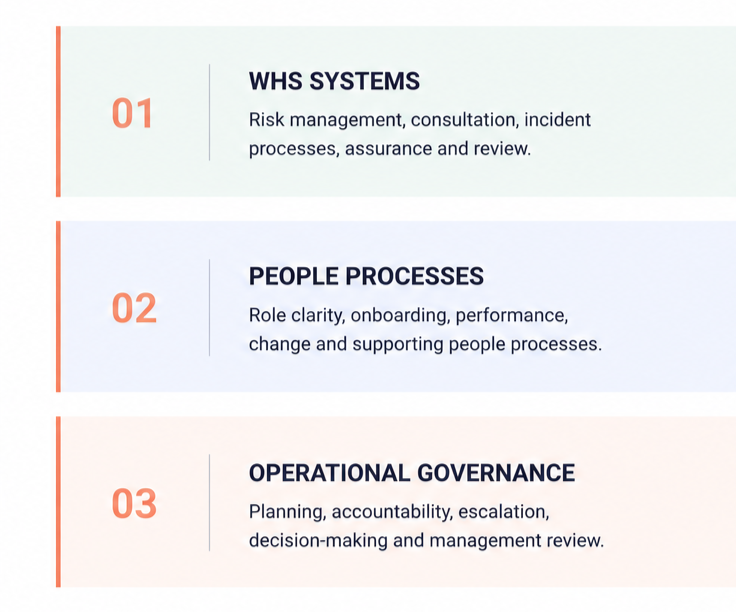
WHERE INTEGRATION OCCURS
Psychosocial risk management needs to connect with the systems that already shape organisational decisions.
Integration is not about creating a separate psychosocial system.
It is about connecting psychosocial risk management with existing organisational processes so responsibilities are clear, information reaches the right decision points and action can be sustained.
Need to strengthen how psychosocial risk management connects across your organisation?
Let’s discuss where clearer integration may strengthen responsibilities, processes and decision pathways.
Once arrangements have been implemented, periodic audit and review can help determine how they are operating in practice.